Polarimetric microscope
A paradigm shift for light microscopy.
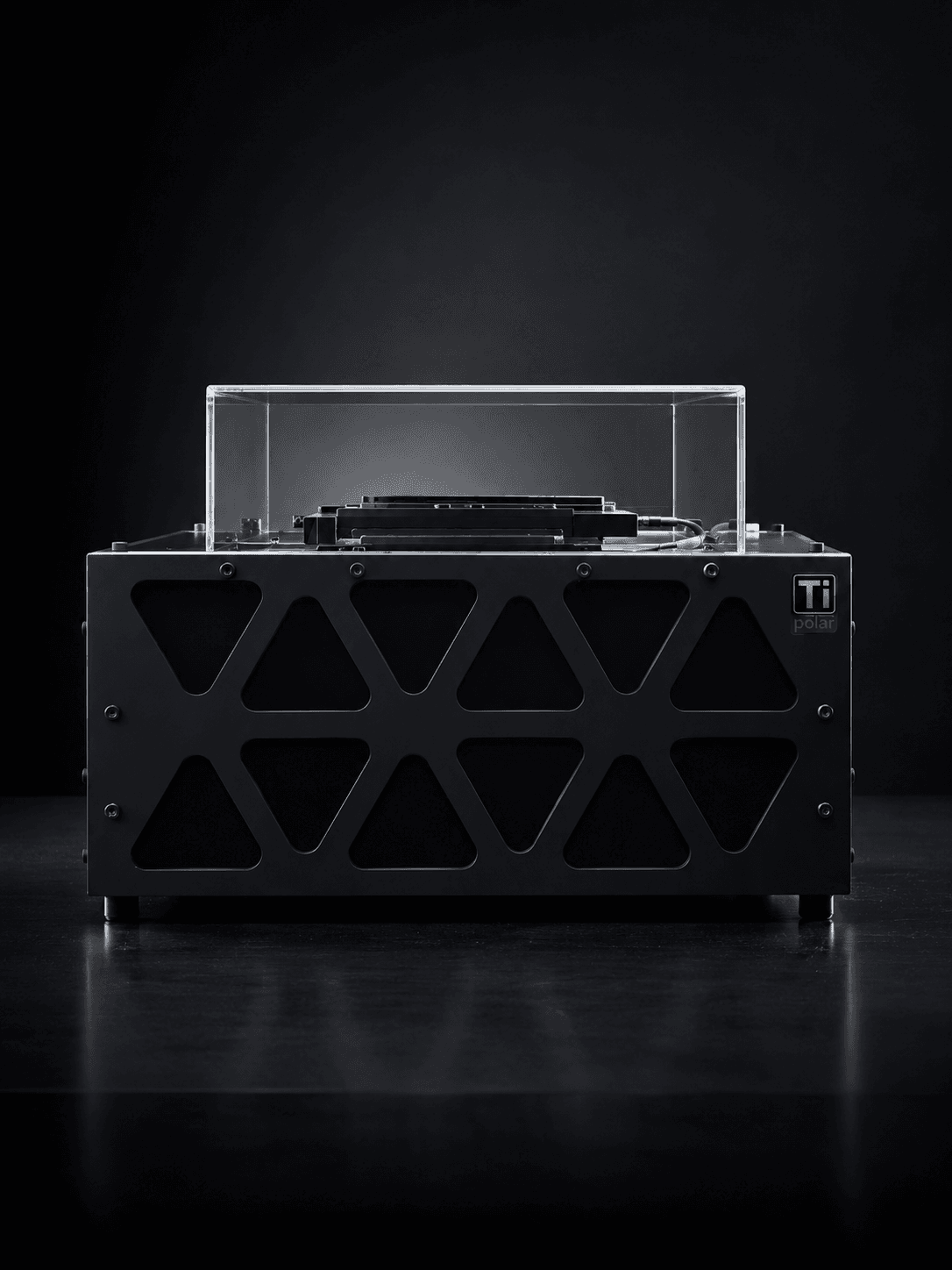
TiPolar is a fully automated metallographic microscope with one defining capability: it turns polarized-light contrast into a measured crystallographic orientation — on an absolute scale, calibrated and validated against EBSD, the SEM-based reference standard. Not a sharper image; a measurement. And it does it in air, on a bench: load your samples, mark where to scan, walk away.
A real measurement
Polarized light: quantified.
Polarized-light microscopy is more than a century old, but it stayed qualitative — orientation-dependent contrast you could see, often beautifully, but couldn't measure. TiPolar-modeTiPolar delivers light across a range of polarization states onto the sample and records how it responds to each. TiPolar-mode does exactly that — automatically — and turns the response into a measurement. changes that: a calibrated acquisition turns the optical signal into per-pixel c-axis orientation in physical units, on an absolute scale. You're no longer inferring qualities about a material — you're measuring quantities.
The bar we hold isn't “repeatable.” It's correct. Every TiPolar calibration is built against EBSD — the SEM-based gold standard for crystallographic orientation — and then validated by holding on independent samples it never saw. When the optical map agrees with that sample's own EBSD, we've shown TiPolar is measuring the same physics — the calibration is a physical model of how the material responds to polarized light, grounded in measured data, not a black-box fit to one sample. That is the difference between a picture and a measurement.
A 1″ × 1″ area at sub-micron pixels scans in ≈ 6.5 minutes on TiPolar. The same scan on an EBSD montage — ≈ 500 px/s versus TiPolar's ≈ 4,000,000 px/s — would take over a month.
- Measures
- Area
- Speed
- Environment
- Sample size
- Role
EBSD validates TiPolar. The two are complementary.
Built for the shop floor
PhD-grade measurement. One-click operation.
Load
Set samples on the stage — one large part or several at once.
Define
Mark the regions you want scanned.
Walk away
Return to finished orientation maps.
Every hard part — the optics, the alignment, the calibration, the analysis — lives inside the instrument. What's left for the operator is simple: load a sample, or fill the stage with several; draw the regions you want; start the run. Come back to finished orientation maps. Decades of polarized-light expertise, compressed into a few clicks. The 120 × 100 mm stage takes a large coupon, a handful of forging cross-sections, or a tray of QC slides at once; fill it, walk away, and the program tells you when to come back and review your results — and with disruptively fast collection speeds, the wait won't be long.
The entire connection
Three USB cables carry data. The instrument and its computer both draw power from the UPS, which plugs into 120–240 V universal mains.
It installs like an appliance, not a lab instrument. Universal mains, 120–240 V, a single power cable, and three USB cables to its computer — that is the entire connection. No vacuum. No active vibration isolation. No environmental conditioning; a granite slab is enough. A built-in UPS rides through power blips and shuts down safely if they last. The instrument that produces a research-grade measurement is meant to sit next to the parts it inspects.
Proven
Crystallographic orientation for HCP metals.
TiPolar measures the c-axis orientation of hexagonal-close-packed metals — and it's proven where it matters most. Alpha-titanium is the primary calibrated system, validated against EBSD. In titanium, c-axis orientation governs dwell-fatigue sensitivity and the microtextured regions that form in rotating components used in aerospace; TiPolar screens for them across whole forging cross-sections, in air, at a scale and speed an SEM chamber can't reach.
The same physics extends across the broader HCP and tetragonal family — zirconium, whose texture governs the performance of the nuclear fuel-cladding tubes it's formed into; magnesium; beryllium; hafnium; the rare-earth metals — and to materials that become measurable through a surface oxide or an etch. If your system isn't calibrated yet, that's a conversation, not a dead end.
Trusted by
TiPolar is deployed at major U.S. aerospace OEMs, U.S. national laboratories, U.S. Department of Defense research centers, primary titanium and metals producers, and international titanium manufacturers and research institutions.
Customer names are confidential by default.
Three ways to engage
Buy one. Send us samples. Or start with a conversation.
Request a quote
Specify your material system, sample envelope, and timeline. We respond with a configuration and a quote.
Get in touch →
Send us samples to scan
Contract scanning, report delivery, and the data files. Useful when you want TiPolar output now without buying the instrument.
Get in touch →
Discuss a material system
If you're not sure whether your material is a fit, this is the right place to start. No obligation.
Get in touch →